
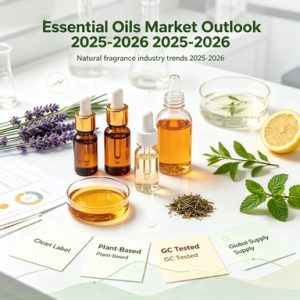
Essential Oils Market Outlook 2025-2026: Trends & Size
Executive Summary
The global essential oils market maintained steady expansion from 2025 to 2026, fueled by rising preference for natural, clean-label ingredients across personal care, food & beverage, aromatherapy, household and pharmaceutical sectors. Divergent estimates exist across research institutions: most data places the 2025 global market value between USD 14.3–19.86 billion, with 2026 market size projected to rise roughly 6%–9% year-on-year. Europe remains the largest regional market, while Asia-Pacific stands as the fastest-growing region, driven by wellness consumption growth in China, India and Southeast Asia. Learn more about our available natural extracts on plant extract raw materials.
Key Market Drivers (2025–2026)
First of all, rising natural wellness and mental health awareness fuels overall market expansion. Specifically, aromatherapy, stress relief and home spa demand lift consumption of lavender, peppermint, eucalyptus and citrus oils for diffusers, massage blends and personal care formulations.
In the second place, clean label and natural cosmetic trends reshape brand choices for raw materials. In fact, regulatory updates on cosmetic raw materials push brands to replace synthetic additives with certified natural essential oils. As a direct result, organic and non-GMO certified oils gain premium pricing power. You can view our cosmetic-grade ingredient portfolio at natural cosmetic additives.
Furthermore, food and beverage brands actively adopt essential oils for flavor and preservation. Simply put, essential oils act as natural flavorings and antimicrobials for beverages, baked goods and functional foods. For this reason, brands drop artificial preservatives in many product recipes.
Lastly, e-commerce channel growth opens accessible new market opportunities. In particular, direct-to-consumer sales via online platforms lower entry barriers for small-batch and specialty oil suppliers. Accordingly, these suppliers expand consumer reach across global regions.
Main Challenges
To begin with, supply volatility and price fluctuation create clear operational risks. For instance, climate events, unstable crop yields and export restrictions directly affect raw material supply of citrus, mint and tree oils.
Moreover, adulteration and certification costs squeeze producer profit margins. On one hand, fake diluted essential oils disrupt overall market pricing. On the other hand, organic, ISO or ECOCERT certification raises ongoing operating costs for producers.
In addition, strict global regulatory differences create extra work for exporters. Notably, safety limits, allergen labeling and food additive approvals differ among the EU, US FDA and Asian authorities. Consequently, this regulatory gap increases compliance burdens for all exporters.
Equally important, sustainability pressure grows steadily each year. Nowadays, buyers actively require traceable, fair-trade and sustainable harvesting practices from their raw material partners.
Segmentation Highlights
By Product
- Lavender Oil: It claims the largest volume share for aromatherapy and cosmetics.
- Citrus Oils (orange, lemon, bergamot): Specifically, brands use these oils widely in F&B and home fragrance.
- Peppermint, Eucalyptus Oil: In turn, they hold strong demand for functional health and household care.
- Specialty oils (rose, sandalwood, frankincense): Meanwhile, they form a high-margin luxury segment; check high purity essential oils for our premium product line.
By Application
- Cosmetics & Personal Care (holds the largest market share)
- Food & Beverage Flavoring
- Aromatherapy & Wellness
- Household Cleaners & Fragrances
- Pharmaceuticals & Animal Feed
Regional Outlook
First and foremost, Europe dominates the global essential oils market. For example, it sees strong demand for certified organic oils, while strict cosmetic allergen rules guide ingredient selection.
Following that, North America delivers steady market growth. More specifically, wellness brands and clean beauty developers continuously boost local consumption.
Besides this, Asia-Pacific records the fastest regional growth. In detail, China’s domestic aromatherapy and natural cosmetic market expands rapidly.
By comparison, Latin America and MEA show gradual market uptake. Generally speaking, most local players focus on raw material production and export.
2025–2026 Notable Industry Trends
For starters, premium certified organic essential oils deliver higher margins for sellers.
Secondly, blended functional oil formulations (sleep, focus, immunity) win steady popularity among end consumers.
Beyond that, vertical integration becomes a common industry strategy. To explain, brands build their own plantations to secure full supply traceability.
In addition to this, green extraction technologies (supercritical CO₂) gain wider adoption for high-purity grades.
Finally, governments and industry associations promote standardized testing to cut down adulteration across the whole supply chain.
Short-Term Forecast Takeaway (2025–2026)
All in all, the market achieves positive year-on-year growth. Even so, raw material expenses and compliance work create consistent profit pressure. Looking ahead, suppliers that maintain stable source chains and complete certification systems will secure greater competitive advantages within the global essential oils trading market.