
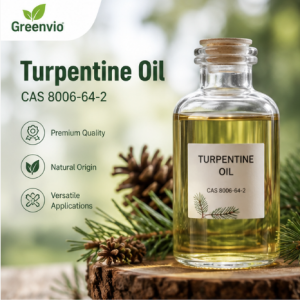
As industries worldwide increasingly seek natural, renewable, and eco-friendly alternatives to petroleum-based solvents, Turpentine Oil (CAS No. 8006-64-2) has emerged as a compelling solution. Derived from the resin of living pine trees, this versatile essential oil combines exceptional solvent power with a renewable origin, making it an indispensable raw material across paints and coatings, fragrances, pharmaceuticals, adhesives, and many other sectors. In this article, we explore the properties, applications, safety considerations, and market outlook of Turpentine Oil, and we explain why it deserves a place in your supply chain.
1. What Is Turpentine Oil?
Turpentine Oil, also known as Spirit of Turpentine, is a volatile essential oil obtained through the steam distillation of oleoresin harvested from living pine trees, primarily from the Pinus genus. Furthermore, the oil has been used for centuries in traditional medicine, painting, and industrial applications. Today, modern distillation techniques ensure consistent quality and purity, enabling manufacturers to rely on it for demanding industrial processes.
Key identification details include:
- CAS Number: 8006-64-2
- EC Number: 232-350-7
- HS Code: 10.00
- Chemical Formula: C10H16 (main component, pinene)
- Molecular Weight: 23 g/mol
- Appearance: Colorless to pale yellow mobile liquid
- Odor: Characteristic strong pine aroma
2. Chemical and Physical Properties
Understanding the physicochemical profile of Turpentine Oil helps buyers and formulators select the right grade for their specific needs. Moreover, these properties directly influence performance in end-use applications such as solvent evaporation rates, dissolution capacity, and safety handling requirements.
The main physical and chemical parameters are summarized below:
- Boiling Point: 154 – 170 C
- Density: 860 – 0.873 g/cm3 (at 25 C)
- Flash Point: 35 – 40 C (closed cup)
- Refractive Index: 467 – 1.477 (at 20 C)
- Vapor Pressure: 4 mmHg (at 20 C)
- Solubility: Insoluble in water; miscible with alcohol, ether, chloroform, and most organic solvents
- Optical Rotation: +30 to +45 (Indian origin)
In addition, the primary active compounds in Turpentine Oil are alpha-pinene (40 – 60%), beta-pinene (5 – 15%), delta-3-carene (15 – 30%), and limonene (2 – 8%). Consequently, these monoterpenes account for the oil strong solvent action and its value as a feedstock for further chemical synthesis.
3. Key Industrial Applications
Thanks to its outstanding dissolving power, moderate evaporation rate, and natural origin, Turpentine Oil serves a remarkably broad range of industries. Furthermore, its versatility allows it to function simultaneously as a solvent, a chemical intermediate, and a fragrance ingredient. The following sections highlight the most significant application areas.
3.1 Paints, Coatings, and Varnishes
Turpentine Oil has long been a preferred thinner and solvent for oil-based paints, varnishes, and alkyd resins. Moreover, its moderate evaporation rate ensures uniform film formation and excellent flow characteristics. Therefore, paint manufacturers value it for achieving smooth, durable finishes on wood, metal, and other substrates.
3.2 Fragrance and Flavor Industry
In the fragrance and flavor (F&F) sector, Turpentine Oil acts as a critical feedstock for isolating alpha-pinene and beta-pinene, which in turn serve as starting materials for synthesizing terpineol, camphor, and various aroma chemicals. Additionally, perfumers and flavor houses rely on consistent, high-purity grades to maintain reproducible scent profiles across production batches.
3.3 Pharmaceutical and Medicinal Use
Pharmaceutical formulators incorporate Turpentine Oil into topical liniments, analgesic balms, and dental cements. Furthermore, its penetrating properties enhance the delivery of active ingredients through the skin. Consequently, it remains a trusted ingredient in both traditional and modern over-the-counter (OTC) preparations.
3.4 Adhesives and Tackifier Resins
Adhesive manufacturers utilize Turpentine Oil as a raw material for synthesizing terpene-based tackifier resins. Moreover, these resins improve the tack, peel strength, and heat resistance of hot-melt and pressure-sensitive adhesives. As a result, they find wide use in packaging, bookbinding, and product assembly.
3.5 Cleaning and Degreasing Products
Owing to its strong grease-cutting ability, Turpentine Oil features prominently in industrial cleaners, metal degreasers, and paintbrush restorers. Furthermore, its natural pine scent provides a pleasant olfactory profile that synthetic solvents often lack. Thus, it appeals to consumers seeking effective yet naturally sourced cleaning solutions.
3.6 Printing Inks, Lubricants, and Insecticides
Beyond the sectors mentioned above, Turpentine Oil also plays important roles in printing ink formulations, where it controls drying time and improves print clarity. Meanwhile, lubricant blenders take advantage of its safe flash-point range, and agrochemical formulators use high-monoterpene grades to boost the bioactivity and penetration of insecticide products.
4. Safety, Handling, and Storage
While Turpentine Oil offers numerous benefits, it also requires careful handling due to its flammability and potential health effects. Therefore, buyers and end-users must follow established safety protocols to protect workers and facilities.
Key safety and handling guidelines include:
- Flammability: Turpentine Oil is classified as a Class 3 flammable liquid (UN 1299) with a flash point of 35 – 40 C. Consequently, keep it away from open flames, sparks, and heat sources.
- Health precautions: High-concentration vapors may cause dizziness, headaches, and respiratory irritation. Moreover, direct skin contact can lead to defatting, dryness, or allergic dermatitis. Therefore, always wear appropriate personal protective equipment (PPE), including gloves and goggles.
- Ventilation: Ensure adequate ventilation in all work areas. Furthermore, use explosion-proof equipment in environments where vapors may accumulate.
- Storage: Store in tightly sealed containers in a cool, dry, well-ventilated area, separate from oxidizing agents and acids. Additionally, avoid prolonged exposure to air and light, which can cause oxidation and discoloration.
- Transportation: Ship in corrosion-resistant steel drums or approved containers with clear flammable-liquid labeling. Moreover, comply with all local and international hazardous-material regulations.
5. Market Outlook and Global Demand
The global market for Turpentine Oil continues to expand, driven by growing demand for bio-based solvents and natural aroma chemicals. Furthermore, stringent environmental regulations in Europe and North America are accelerating the shift away from petroleum-derived thinners, which in turn boosts the appeal of pine-based alternatives. Meanwhile, key producing regions such as India, China, Brazil, and Southeast Asia are scaling up distillation capacity to meet rising export demand.
In addition, downstream derivative markets — including synthetic camphor, terpineol, and terpene resins — are experiencing steady growth, thereby reinforcing the long-term demand for high-quality Turpentine Oil. Consequently, buyers who secure reliable supply agreements now will be well positioned to navigate future market fluctuations.
6. Why Source Turpentine Oil from Us?
We supply premium-grade Turpentine Oil (CAS 8006-64-2) with full documentation and batch-level traceability. Moreover, our quality assurance process includes GC-MS analysis and GHS-compliant Safety Data Sheets (SDS) for every shipment.
- Consistent quality with pinene content above 85% and purity up to 99%
- Flexible packaging options: 25 kg HDPE drums, 180 kg steel drums, IBC totes, and FCL containers
- Complete documentation: COA, SDS/MSDS, Certificate of Origin, and REACH compliance on request
- Competitive pricing with manufacturer-direct supply and no reseller margins
- Reliable global logistics with air and sea freight options to major ports worldwide
- Dedicated export desk responding to inquiries within 24 hours
Whether you operate in paints and coatings, fragrances, pharmaceuticals, or adhesives, we invite you to contact our team for product specifications, sample requests, and bulk pricing.
7. Conclusion
In summary, Turpentine Oil (CAS 8006-64-2) stands out as a natural, renewable, and highly versatile solvent that serves an impressive array of industries. Furthermore, its strong solvent power, rich pinene content, and natural pine aroma make it an ideal choice for manufacturers seeking sustainable alternatives to petroleum-based chemicals. Therefore, as global demand for bio-based raw materials continues to grow, Turpentine Oil will undoubtedly remain a cornerstone of the fine chemicals landscape for years to come.
If you have any questions or would like to request a quotation, please do not hesitate to reach out. We look forward to supporting your business with consistent quality and dependable service.
Contact Us
For inquiries, samples, and bulk orders, please contact our export team. We respond to all serious procurement requests within 24 hours.